
What can we learn from a dead red squirrel?
Here at SSRS we use a lot of data to inform our work, determine priority areas and track the success of the project. From public sightings to camera trap images and hair sample ID, we gather this data from lots of different places, and in collaboration with many different people! One area we’re really interested in is red squirrel health across the country, particularly monitoring the prevalence of the deadly squirrelpox virus, which is carried by some grey squirrels. We caught up with Liam, from the Royal (Dick) School of Veterinary Studies, who carries out post mortems on red squirrels collected by SSRS and the public, to find out more about all the information we can learn from these.
The below post contains images of dead red squirrels.

Hi, I’m Liam Wilson, one of the vet pathologists at the University of Edinburgh, and I help run the mortality monitoring scheme for Scotland’s red squirrels. As you probably know, our native reds in the UK are under pressure from disease and from competition for food with the invasive non-native grey squirrel.
At the Royal (Dick) School of Veterinary Studies and the Roslin Institute, we’ve been running a mortality monitoring programme since 2005. This aims to understand the main causes of death in Scottish red squirrels, and to investigate any factors that might make them more vulnerable to certain threats, such as disease or in-breeding.
As part of this, we ask members of the public to send us dead red squirrels they find in the environment. We often get asked questions about how this all works, so I hope to answer some of these here.
- Why are red squirrel post-mortem examinations carried out in the UK?
Post-mortems are one of the few practical ways of investigating disease in wild populations. Continuously monitoring every woodland across Scotland for signs of illness in local red squirrels would be prohibitively expensive, and even then, many diseases with no obvious signs would likely go undetected until it was too late.
By examining animals after death, we can determine the primary cause of mortality in each case. When these findings are combined over multiple incidences, they provide valuable insight into the broader drivers of mortality affecting Scotland’s red squirrel population.
- Do post-mortems test for squirrelpox virus?
Yes – one of the most important reasons for conducting post-mortems is to test for squirrelpox virus. We first look for the typical external lesions of ulcers or scabs around the eyes, mouth or the inside of the forelimbs. If lesions are present, we then test in the laboratory whether or not these are related to squirrelpox, as they could be from another cause such as trauma, a bite or an abscess. Once we have these results, if the case is confirmed as squirrelpox, our colleagues in SSRS can follow up with local action such as removing and disinfecting garden feeders, and encouraging extra vigilance in that area.
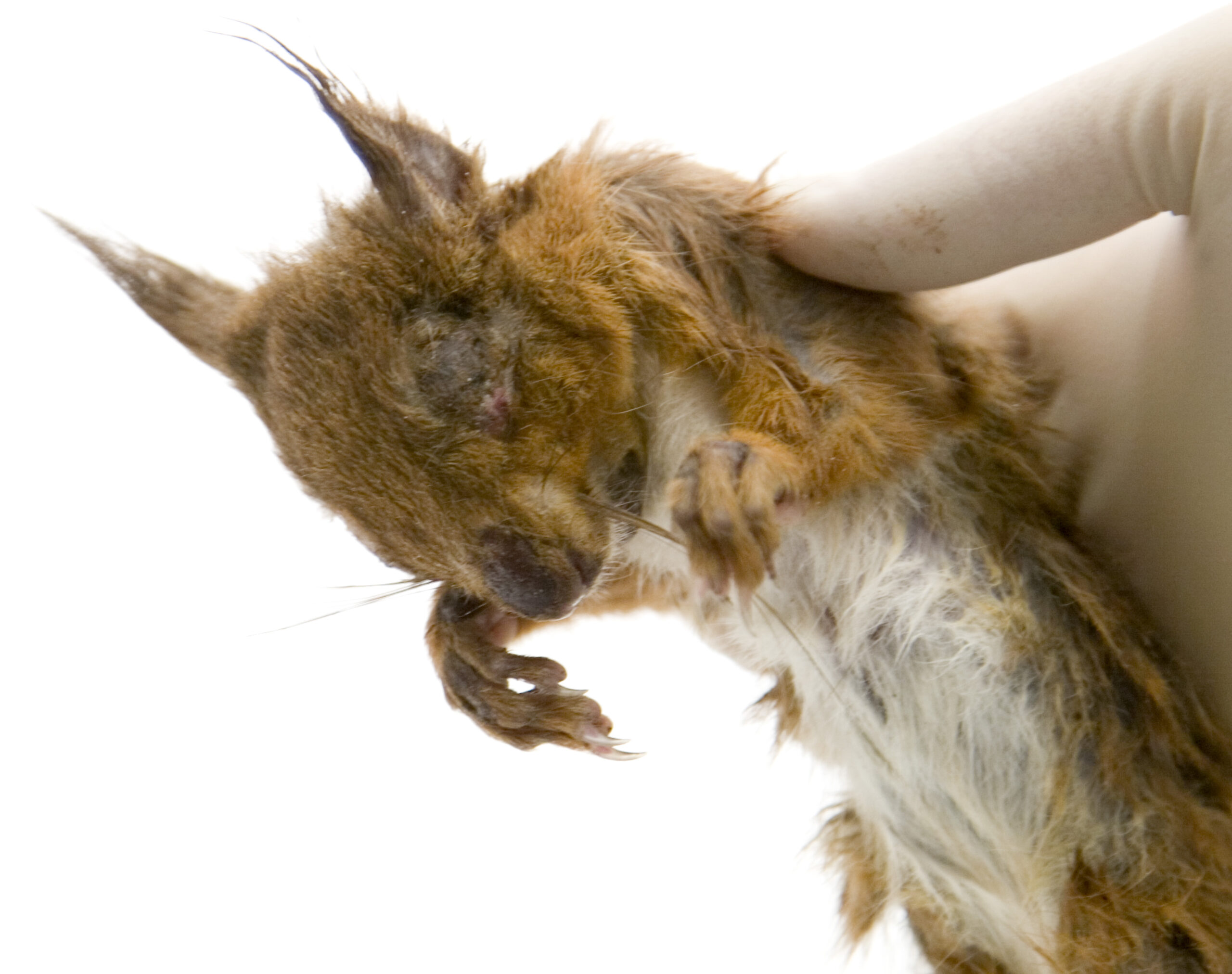
A dead red squirrel with squirrelpox (Moredun Institute)
- I’ve found a dead red squirrel. How do I submit this for a post-mortem?
If you wish to send us a dead red squirrel, please follow the guidance for how to handle, store and send the body for examination and use the form available on the SSRS website here. If you have any questions please email , or feel free to get in touch with me liam.wilson@ed.ac.uk or our reception team ebp.enquiries@ed.ac.uk.
Generally speaking, the animal needs to be appropriately packaged, labelled and sent via next-day or first-class delivery. It’s important to not have any direct contact with the body, so picking it up is best done using a plastic bag around your whole hand, as you would with a dog poop! It’s also really helpful to fill in the submission form as fully as possible. This gives us valuable information for our database, to get as much from each case as we can.
- What condition does the squirrel have to be in?
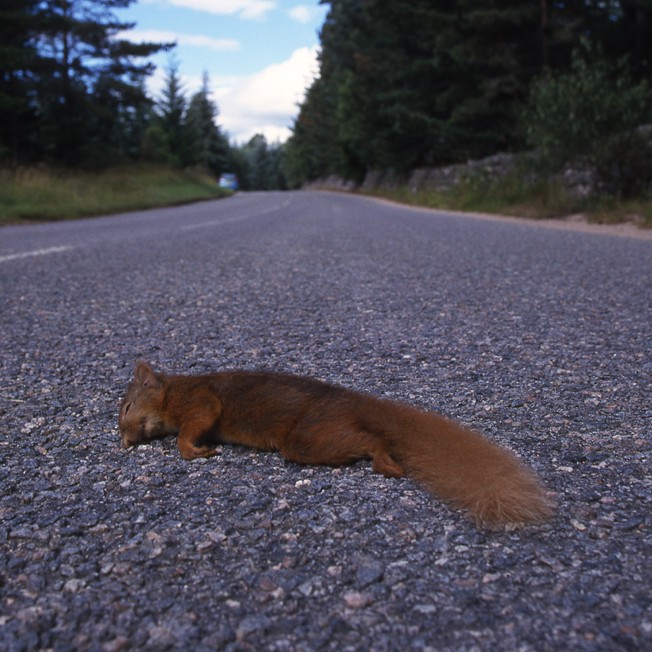
Almost any dead red squirrel can be useful for our monitoring programme. However that being said, the more decomposed or scavenged a case is, the harder it is for us as pathologists to state a cause of death, as I need to be able to see the changes in the tissues in order to make a diagnosis. It often surprises how sometimes even very decomposed squirrels still have enough remnant tissue to allow a conclusion to be reached, so you never know! A good rule of thumb is that if the body is mostly intact, with the internal organs still present, then it’s probably worth sending to us even if the body has extensive trauma such as being from a car accident. In such cases, we might not be able to tell if the squirrel had an underlying illness that made it more likely to get hit, like a pneumonia for example, but we can still sample the tissues as part of the ongoing monitoring.
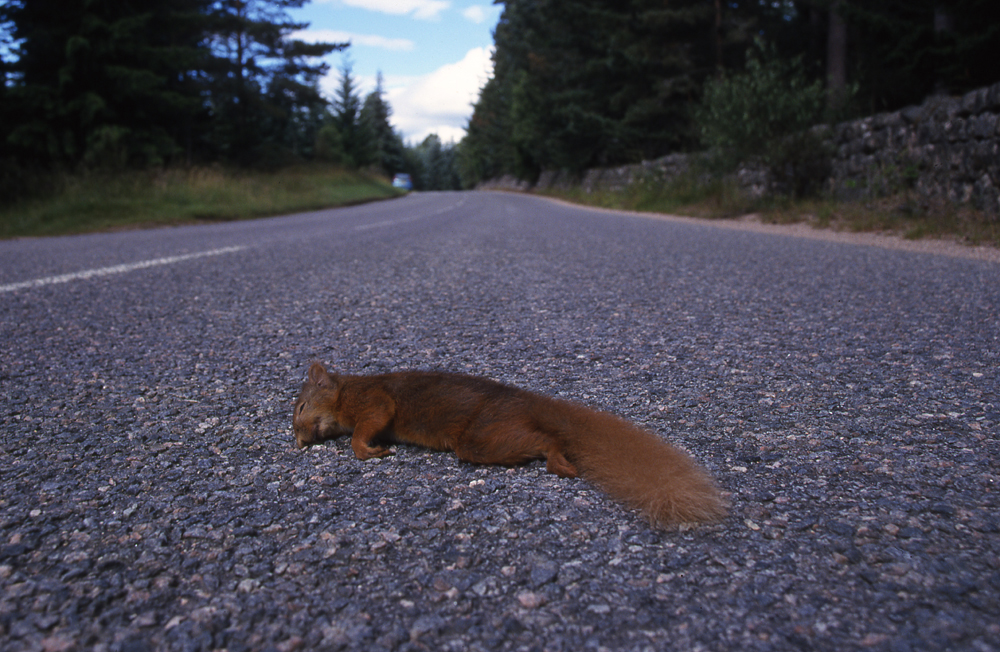
A red squirrel sadly found dead in the middle of a road (Dennis Johnson).
- What does the post-mortem involve?
A post-mortem generally involves a pathologist carrying out a thorough external and internal examination to determine the cause of death. We use specialist equipment to make sure we aren’t infected by any disease the animal may be carrying. If you’ve ever seen a crime drama, it’s a similar sort of process but on a much smaller scale!
We often take tissue samples to help us narrow down our list of potential causes of death; for example, a small piece of lip in a suspected squirrelpox case. We also take other tissue samples to support related research projects into squirrel health. All of this work has undergone an ethical review process and aims to advance red squirrel conservation in Scotland, the rest of the UK and beyond.
- How do I find out what caused a squirrel to die?
After each post-mortem exam, we produce a report which is sent to the person who submitted the body, and the local SSRS officer. It’s worth bearing in mind that sometimes it can be difficult to definitively determine why a squirrel died, but we try to give an indication as far as we can.
- How long does it take to get these results?
We perform these post-mortem examinations without any funding for them, and therefore have to fit these around other diagnostic and teaching commitments taking place in our post-mortem facilities. This means it can take a couple of months for a final report to be produced and sent. If there’s a suspicion of something serious such as squirrelpox, however, we try to get these results determined as quickly as possible.
- What sort of other projects are ongoing relating to these samples?
In addition to the cause of death in each squirrel, we compare things such as age, sex, and location, to determine potential disease risk factors.
We can also use this data to identify local outbreaks of squirrelpox, or pinpoint areas where squirrelpox or other diseases may not be as common as we would expect them to be, which then allows us to target these areas for further investigative work.
The samples taken during the post-mortem are used for numerous other projects aiming to help red squirrel conservation. These include identifying the low genetic diversity among Scotland’s red squirrels due to a historical bottleneck1 and identifying the prevalence of leprosy2 which reds can carry without clinical signs.
Summary:
As you can see, submitting bodies for these examinations provides a key resource for us to investigate numerous aspects of red squirrel disease and conservation, none of which could be achieved without many local volunteers and volunteer groups. Please do submit any red squirrel bodies you come across and feel free to reach out to me with any questions you may have.

A live red squirrel! (Steve Gardner)
References:
- Marr, M. M. et al. Genomic Insights Into Red Squirrels in Scotland Reveal Loss of Heterozygosity Associated With Extreme Founder Effects. Evol. Appl. 18, e70072 (2025).
- Zhou, Z. et al. Molecular and Serological Surveillance for Mycobacterium leprae and Mycobacterium lepromatosis in Wild Red Squirrels (Sciurus vulgaris) from Scotland and Northern England. Animals 14, (2024).